
Your phone buzzes. The caller says it's about your car loan and gives a company name you've never heard of. You applied online this week, and maybe at the car yard too. So the caller could be the yard that sells you the car, a broker that arranges the loan, or the lender that lends you the money. The lender is the company you repay, so find out which one is calling.
A car loan can take years to repay, and your licence and income details go to whoever you apply with. Find out who's who before you send them.
A lender lends you the money and decides on your application. A broker arranges the loan with a lender. A car yard sells you the vehicle, and may arrange finance too.
The law makes the lender tell you its name before you sign. We're not the lender: our advisers help arrange finance with lenders on our panel.
Who lends you the money?
The lender does. It decides on your application, lends you the money, and takes your repayments.
The lender must also tell you who it is. The Credit Contracts and Consumer Finance Act 2003 says it must give you its full name and address before you sign the loan contract. If it trades under another name, it must give you that too.
What does a broker do?
A broker takes your application to a lender, and the lender decides.
That's what Motor Vehicle Finance does. You tell us about the vehicle and about you, and we send your application to a lender on our panel. That lender makes the decision. Our Important Information page lists the lenders on our panel.
A specialist explains each step, from your first question. Every step, explained.
Does it matter who arranges the loan?
Yes, because the company you talk to may not be the company you repay.
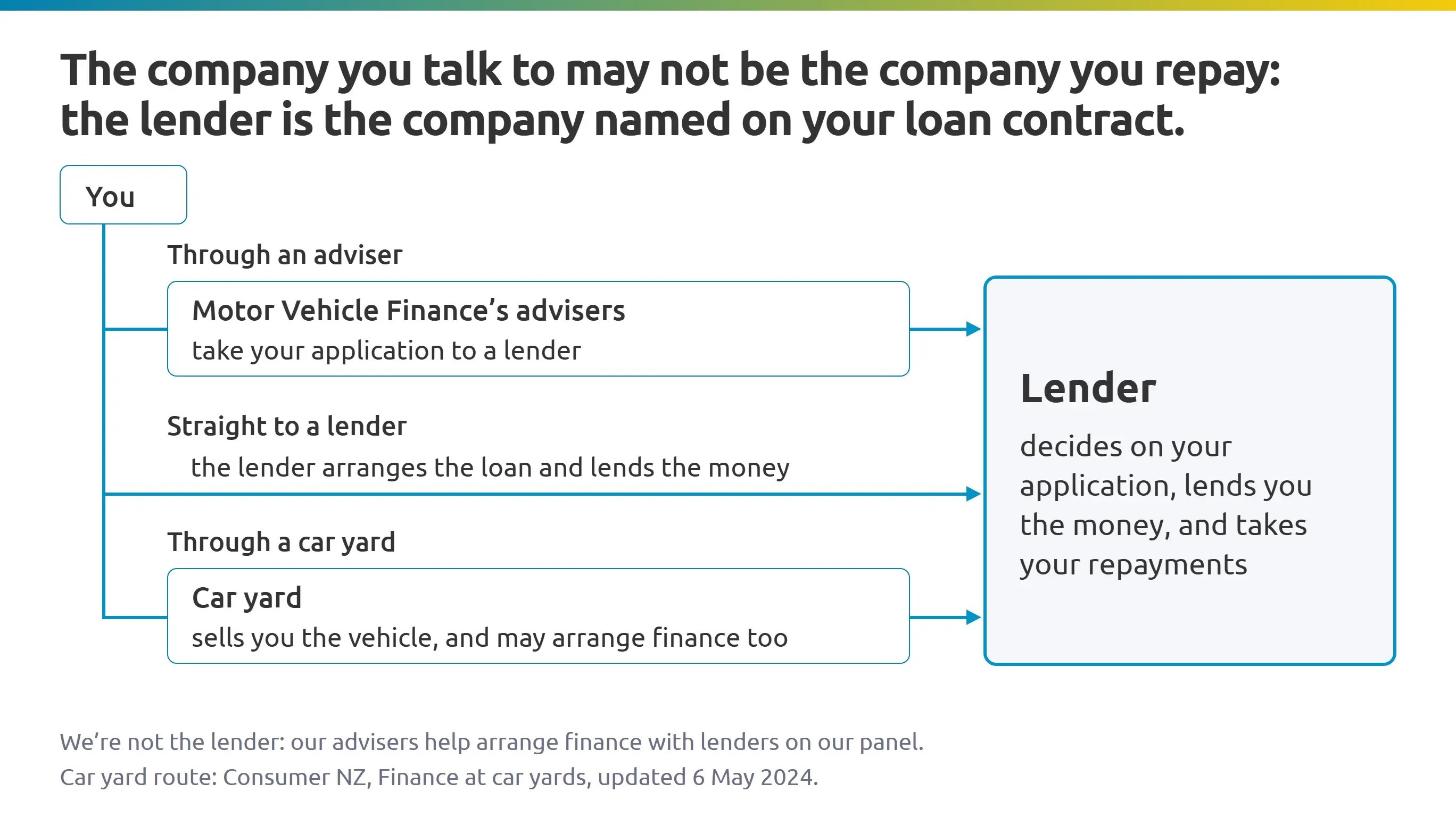
Sometimes one company does both. Go straight to a lender, and the lender arranges the loan and lends the money. Consumer NZ says many big car brands have in-house finance, so the brand on your car can be the lender too.
Either way, the lender is the company named on your loan contract.
What is dealer finance?
Dealer finance is a loan the car yard arranges when it sells you the vehicle. Consumer NZ says dealers outside the big brands usually offer loans through finance companies. So a yard can sell you the car and arrange the loan, and a finance company lends you the money.
Motor Vehicle Finance isn't a car yard. We don't sell vehicles. We help arrange finance for the one you choose.
Buying privately or from a dealer? We work with both, provided the vehicle meets lender criteria.
How do you check who you're dealing with?
Make three checks, in this order.
- Ask the caller for the company's full name. Then ask: are you the lender, or are you arranging the loan?
- Search that name on the Financial Service Providers Register. It lists the people, businesses and organisations registered to offer financial services in New Zealand, and you can search it by trading name or FSP number. To check us, search FSP403346.
- Before you sign, look for the lender's name in the papers it gives you. That is the company you will repay.
Start with the first question
Next time someone calls about a car loan with a company name you don't know, ask the first question: who are you, and are you the lender? When you're ready, apply for car finance with Motor Vehicle Finance. Approval is subject to responsible lending inquiries and lender criteria.
We help arrange finance through our panel of lenders — we are not the lender. Approval is subject to responsible lending inquiries and lender criteria.
Disclaimer: Please note that the content provided in this article is intended as an overview and as general information only. While care is taken to ensure accuracy and reliability, the information provided is subject to continuous change and may not reflect current developments or address your situation. Before making any decisions based on the information provided in this article, please use your discretion, and seek independent guidance.